Roofing Software Comparison: CRM vs. Estimating vs. Supplement Tools
Kelvin Spratt
Founder, Supplement Snap · March 3, 2026
Revenue Gap
$20,000–$30,000/mo
Left on the table by contractors with no supplement tool (10 jobs/month)
Key Takeaways
Compare the three categories of roofing software: CRM, estimating, and supplement tools. Learn what each does, when you need each one, and where the gaps are costing you money.
The three categories of roofing software
If you run a roofing company in 2026, you have more software options than ever. But most of it falls into three distinct categories, each solving a different part of your business:
CRM (Customer Relationship Management): manages your leads, appointments, follow-ups, and sales pipeline
Estimating software: helps you measure roofs, calculate materials, and produce quotes
Supplement tools: document hidden damage found during tear-off and generate insurance supplement reports
Each category solves a real problem. But most roofing contractors invest heavily in one or two of these categories while completely ignoring the third, and that blind spot is costing them thousands of dollars per job.
Understanding what each type of software actually does, where they overlap, and where the gaps are is the first step to building a tech stack that doesn't leave money on the table.

CRM software: managing leads and customers
Roofing CRMs are the most widely adopted category of software in the industry. Popular options include JobNimbus, AccuLynx, Leap, RoofLink, and HailTrace. These platforms focus on the sales and project management side of your business.
What a roofing CRM typically does:
Tracks leads from first contact through closed sale
Manages appointments and follow-ups with automated reminders
Stores customer information, property details, and insurance claim data
Provides a pipeline view showing where each job stands
Handles contracts, change orders, and digital signatures
Coordinates production scheduling and crew assignments
Sends automated text and email updates to homeowners
Generates reports on close rates, revenue, and sales rep performance
A good CRM is essential once you're doing more than a handful of jobs per month. Without one, leads fall through the cracks, follow-ups get missed, and you lose track of where each project stands. Most established roofing companies already have a CRM, and for good reason. It directly impacts how many leads you convert into signed contracts.
However, a CRM does not help you recover more money on the jobs you've already sold. It manages the customer relationship, not the technical documentation needed to maximize claim value.
Estimating software: measuring and quoting
Estimating tools help you produce accurate measurements and material calculations before the job starts. The most common tools in this space include EagleView, GAF QuickMeasure, Hover, RoofSnap, and iRoofing.
What estimating software typically does:
Generates roof measurements from satellite imagery or drone photos
Calculates squares, waste factor, ridge length, valley length, hip length, and eave length
Produces material lists for ordering
Creates professional estimates and proposals for homeowners
Integrates with supplier pricing for accurate material costs
Some tools include labor cost calculators based on roof complexity
Estimating software saves significant time compared to hand-measuring every roof, and the accuracy of satellite measurement tools has improved dramatically. For insurance work, tools like EagleView provide reports that adjusters recognize and accept.
The limitation of estimating software is that it captures the roof as it appears from the outside, before tear-off. It tells you the dimensions, pitch, and features of the roof. It does not capture what's hiding underneath the shingles. Rotted decking, corroded flashing, missing ice and water shield, deteriorated pipe boots. None of this shows up in a satellite measurement or a pre-job inspection.
Supplement tools: capturing hidden revenue
Supplement tools are the newest and least adopted category of roofing software. They focus on a specific problem: documenting concealed damage found during tear-off and converting that documentation into insurance supplement requests.
What a supplement tool typically does:
Enables field crews to capture and tag damage photos during tear-off
Records voice notes and field observations in real time
Generates professional supplement narratives explaining what was found
Maps damage to Xactimate line codes with correct quantities and pricing
Exports Xactimate-compatible CSV files for adjuster submission
Produces PDF reports with photos, narratives, and findings summaries
Tracks supplement status from submission through approval
The core value proposition is simple: on a typical insurance tear-off, your crew discovers $1,500–$3,200 in hidden damage that wasn't included in the original adjuster estimate. A supplement tool ensures that damage gets documented properly and submitted to the carrier for additional payment.
Without a supplement tool, that documentation process relies on crew members texting blurry photos to the office, someone writing up the supplement days later from incomplete information, and hoping the adjuster approves it despite the weak evidence.
The gap most contractors don't see
Here's the pattern across the roofing industry: almost every established contractor has a CRM. Most have some form of estimating tool. But very few have a dedicated supplement tool.
This creates a predictable revenue leak. Consider a typical insurance job:
The CRM tracks the lead from door knock to signed contract, working perfectly
The estimating tool produces accurate measurements and a material order, working perfectly
The crew tears off the roof and finds rotted decking, failed flashing, and missing ice and water shield
Nobody has a system to document the hidden damage properly
The supplement either doesn't happen, or it gets submitted with a blurry photo and a one-line description
The adjuster denies it or the office never bothers submitting it
$2,000+ in legitimate, recoverable revenue disappears
This happens job after job, month after month. A contractor doing 10 insurance roofs per month might be leaving $20,000–$30,000 on the table every month, not because the damage isn't there, but because they don't have a system to capture it.
The irony is that contractors will spend $300–$500/month on a CRM to close more deals but won't invest in a tool that recovers $2,000+ per job on deals they've already closed. The ROI on supplement documentation is dramatically higher than almost any other software investment a roofing company can make.
Overlap and integration between the three categories
There's some overlap between these categories, but less than you might expect:
Some CRMs include basic estimating features, but they rarely match the accuracy of dedicated measurement tools
Some estimating platforms include CRM-like features for managing jobs, but they lack the depth of a dedicated CRM
A few CRMs have started adding 'supplement tracking' features, but these are typically just status fields. They don't help with the actual documentation, narrative generation, or Xactimate export
The reality is that each category solves a fundamentally different problem at a different stage of the job:
CRM: pre-sale through project completion (customer-facing)
Estimating: pre-job measurement and quoting (planning-focused)
Supplement: during and after tear-off (revenue recovery)
The most productive roofing operations use all three categories in combination. The CRM manages the customer relationship and project pipeline. The estimating tool produces accurate measurements and material orders. The supplement tool captures hidden damage during tear-off and recovers additional revenue.
When evaluating any roofing software, ask yourself: does this tool help me close more deals, plan jobs more accurately, or recover more revenue from jobs I'm already doing? If you're strong on the first two but have nothing for the third, you've identified your biggest opportunity.
Why supplement documentation should be your next investment
If you already have a CRM and an estimating tool, the highest-ROI addition to your tech stack is a supplement documentation platform. The math is straightforward:
Average supplement recovery: $1,500–$3,200 per job
Percentage of insurance tear-offs with supplementable damage: 70–90%
Cost of a supplement tool: $99–$299/month
Breakeven: one approved supplement pays for months of the software
The key is choosing a tool that actually solves the documentation problem, not just a status tracker. You need something your crew can use on the roof during tear-off to capture photos, tag damage types, record voice notes, and generate professional reports before they leave the job site.
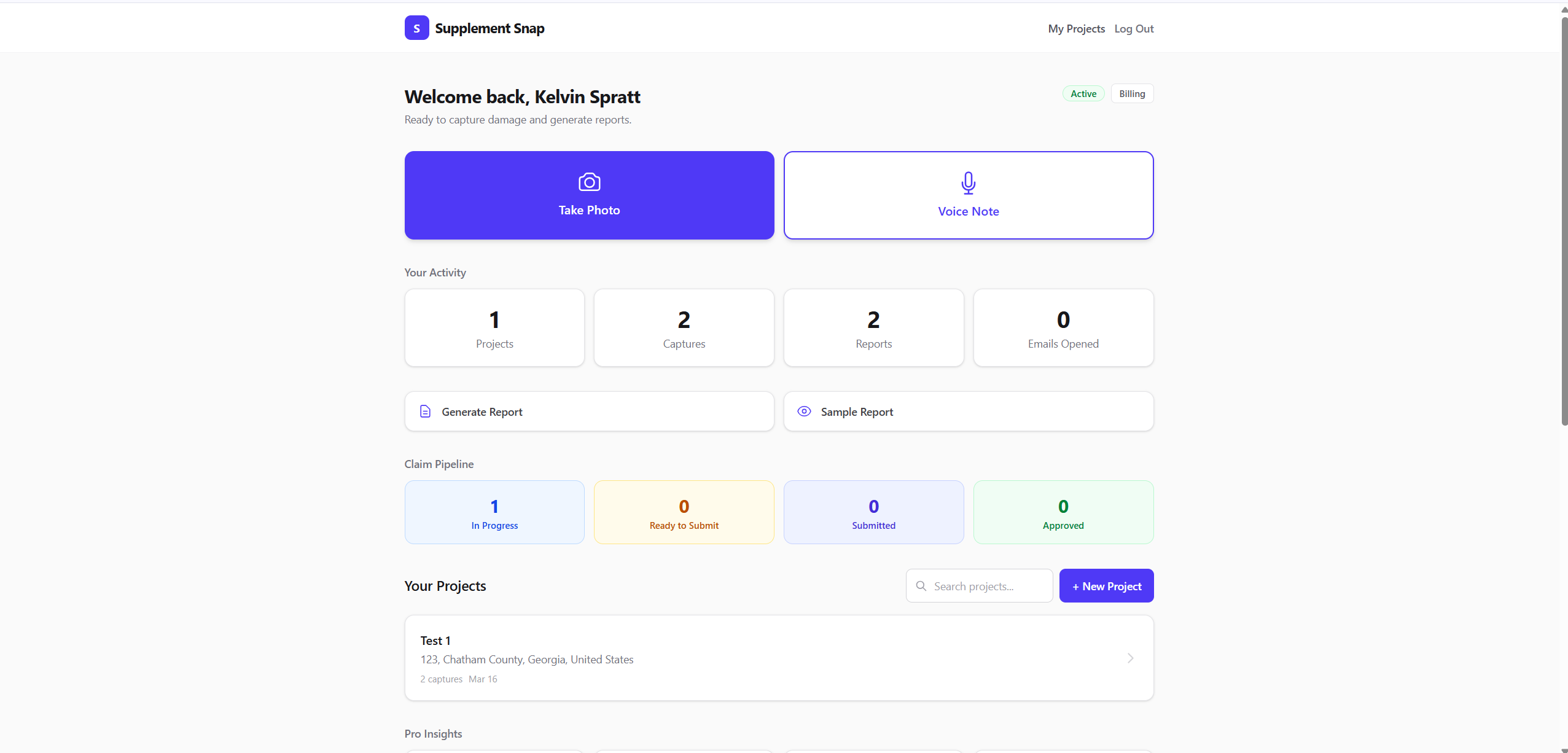
Supplement Snap was built specifically for this workflow. Your crew captures damage findings from the roof with tagged photos and voice notes. The AI generates professional supplement narratives. You export Xactimate-ready CSV files and email a PDF report to the adjuster the same day. It fills the gap that your CRM and estimating tool were never designed to address, and it pays for itself on the very first job.
Stop investing only in software that helps you win jobs. Start investing in software that helps you get paid fully for the jobs you've already won.
For a deep dive into CRM options specifically, check out best roofing CRM.
References & Resources
Ready to streamline your supplement process?
Supplement Snap helps your crew capture hidden damage during tear-off and generate adjuster-ready reports in minutes.
Written by
Kelvin Spratt
Founder, Supplement Snap
Kelvin builds software for roofing contractors who are tired of leaving supplement money on the table. His background in software development and insurance restoration workflows drives everything Supplement Snap does.